



-


-
Statistics
- Statistics on the effectiveness of online advertising
Statistics on the effectiveness of online advertising
Over the last few years, the active development of the Internet has stimulated the spread of online advertising. Increasingly, the Internet is being used simultaneously with television, both by users and advertisers. The spread of the Internet does not replace other media, especially TV, but rather complements them. The Internet is being recognised as an important tool for influencing customers and preparing them to buy. For example, a 2010 FEVAD-Mediametrie barometer study showed that 78 per cent of Internet users look at product information on websites before making a purchase. The Internet also facilitates the emergence of new platforms for advertising, such as social media, whose influence and role in today's society can no longer be underestimated and the presence of companies in social media is becoming an integral part of their marketing strategy. The expansion of advertising opportunities thanks to the Internet leads to the emergence of new formats and methods of advertising aimed at the target audience. At the same time, the growing number of advertising formats and spaces requires new methods of assessing the real visibility and effectiveness of advertising. New methods of targeted advertising based on behavioural stereotypes are emerging, which increases the effectiveness of advertising campaigns, while multimedia and video advertising opens up opportunities for new consumer relationships with the brand, including in social media.
Seven key approaches to assessing the effectiveness of online advertising
Monitoring the performance of online advertising is becoming a major challenge.
Numerous metrics exist, but the most widely used is still the CTR (clickthrough rate). However, this ratio underestimates the real impact of graphic advertising on brand image.
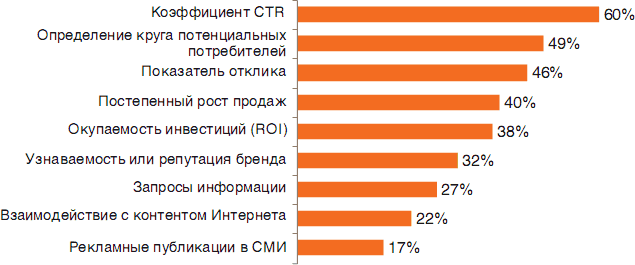
Figure 1: Metrics used by advertisers in the US to measure the results of x online marketing campaigns.
A 2009 comScore study shows that the number of people clicking on online advertising links and banners is gradually declining. Between 2007 and 2009, the number of Internet users clicking on advertising links and banners dropped by 50%, and in 2009, only 16% of Internet users clicked on advertising links. Moreover, almost all "clicks" come from a very small proportion of Internet users (85% of clicks come from 3% of users). The characteristics of Internet users who click on advertising links are also very specific (young people between the ages of 25 and 44 with incomes of less than $40,000 per year), and they are not very specific (young people between the ages of 25 and 44 with incomes of less than $40,000 per year). They do not always match the advertisers' target audience1.
The main disadvantage of CTR is that it does not provide information about the impact of an ad in terms of potential buyer awareness, ad memorability, buyer loyalty or purchase intent.
Consequently, specialised evaluation tools are needed to effectively monitor online advertisements.
The following are the main approaches to evaluate the effectiveness of online advertising.
Defining the objectives of the online communication strategy
To be effective, the Internet must be incorporated into the overall marketing strategy.
There are many indicators that allow for a more specific and often more rapid evaluation of online advertising. However, a wide range of metrics does not always provide a proper assessment of the effectiveness of a marketing strategy. Some advertisers face the risk of infobesity. It is more important for advertisers to collate and compare data across different media (Internet, TV, radio, press, etc.) rather than simply evaluating data using a wide range of metrics. Most advertisers emphasise the need for integrated evaluation and monitoring systems, especially in the following three areas:
- Understanding advertising media reach and repeatability
- Analysing the brand impact of advertising campaigns
- Evaluating the impact on sales
More sophisticated advertisers are developing strategies that encompass all media types. Thus, online strategy should not be considered in isolation, but in terms of its contribution to overall marketing and commercial objectives.
Given that the objectives may be different, it is necessary to define and implement indicators that correspond to these objectives.
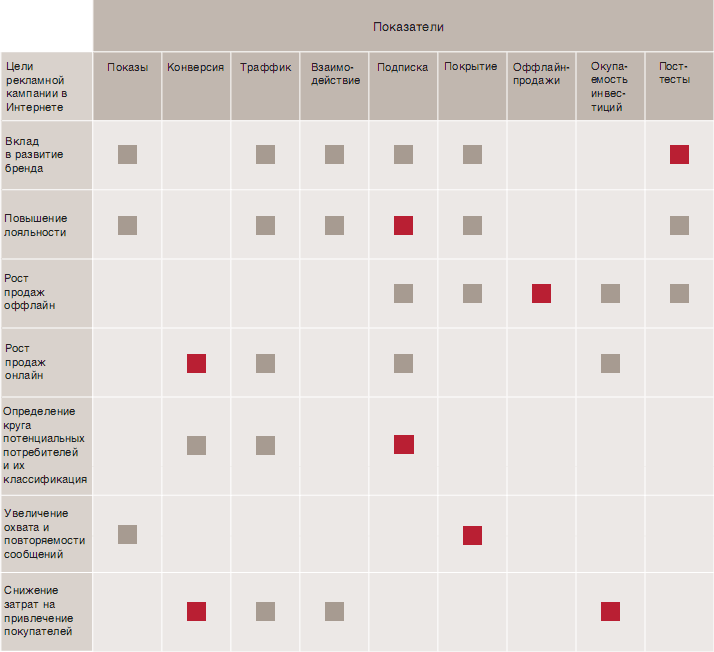
We have formulated a rough list of the different objectives that can be set for an online advertising campaign.
- Branding: the aim of branding campaigns is to reinforce various brand components such as recognition, image or purchase intentions. These campaigns are usually part of a broader media strategy and are most often evaluated for their cumulative effect together with other media.
- Customer loyalty work is also carried out as part of branding and aims to enhance the consumer's experience of the online relationship with the brand, but with the specific aim of engaging directly with the internet user.
- Increasing offline sales (traditional sales) continues to be the ultimate goal of a branding campaign, with the exception of image advertising. Achieving this goal may be more important for specific campaigns and hence can be evaluated with greater precision.
- Increase in online sales: these campaigns are primarily aimed at increasing sales on the brand's website or partner networks. Such campaigns can also pursue advertising and branding effectiveness simultaneously.
- Identifying the circle of potential consumers is based on a results-oriented method, but does not aim to increase online purchases. The aim is to study the range of people using interactive Internet resources such as games and questionnaires for categorisation purposes.
- Increasing the reach and repetition of messages: as Internet penetration increases, it is rapidly becoming a mass medium that can increase the impact of an advertising message. One of the objectives of Internet campaigns may be to expand the reach of the message and ensure repeatability in other media.
- Reducing the cost of customer acquisition can be another goal of Internet campaigns. For results-oriented advertisers, it is the primary one.
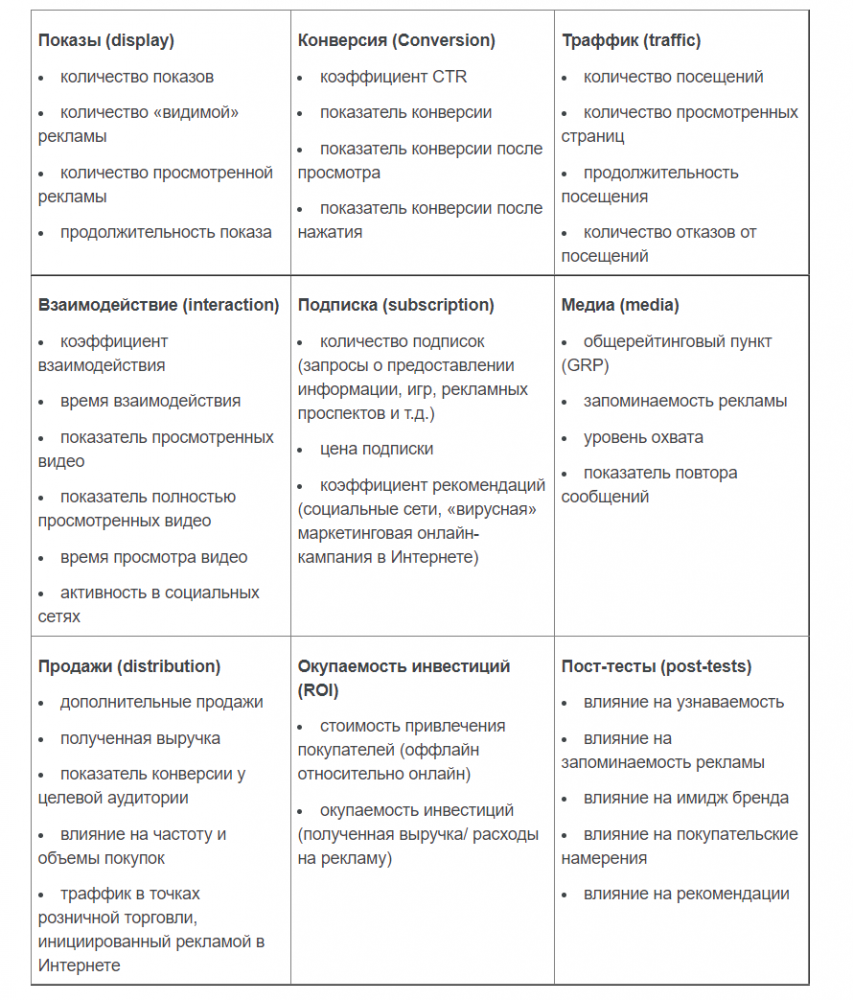
Different metrics can be used to achieve each of the above goals. The following is a basic, but by no means exhaustive, list that gives an idea of the evaluation tools available to advertisers. The same indicator can be used in many cases to measure the achievement of different objectives.
9 types of metrics for evaluating the effectiveness of online activity
Indicators aligned with specific objectives
Evaluating the contribution of the Internet to branding objectives
In addition to CTR rates, several studies have assessed the impact that the Internet has on brand awareness, memorability and brand image.
Although advertisers still tend to use television to build and enhance brand awareness, many studies show the potential impact of the Internet on various brand components.
Impact on brand awareness
To determine the impact of advertising on brand awareness, Nielsen analysed the impact of several campaigns shown on television and then on the Internet.2 It found that in some sectors, such as automotive and beverages, the Internet delivered brand recall twice as well as television (see Figure 2). This high performance of the Internet can be explained in particular by the number of advertising inserts.
Improved brand image
Several studies have also found a positive impact of the Internet on brand image. For example, an analysis of McDonalds' 2009 media advertising campaign shows that an online advertising campaign increased brand identification by 10%. Similarly, a campaign by L'Oreal resulted in a 9% increase in brand identification3.
Positive impact on purchase intention
In a study of graphic ad campaigns by four advertisers from different industries, Mediametrie NetRatings found that the purchase intent of Internet users who viewed these ad campaigns increased by 11%4.
Evaluating the impact of advertising campaigns
Conducting post-tests is still the benchmark method for evaluating the brand impact of advertising campaigns. Realising this, advertisers are increasingly conducting ad-hoc analysis online. Using metrics other than CTR can help determine the impact of online advertising on branding.
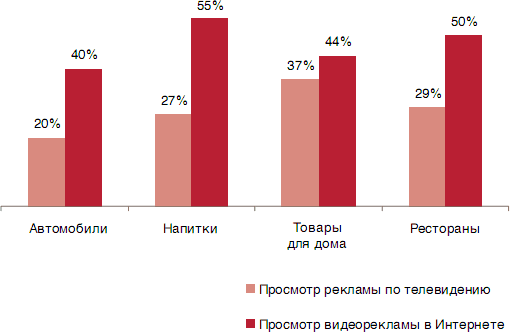
Figure 2: Brand recall among viewers after viewing a video ad on television or online, Nielsen IAG Panel, 2009.
By measuring exposure, advertisers understand the visibility of graphic ads and recognise the average length of time Internet users are exposed to an ad. This metric will be increasingly used in the future as measurement methods become more standardised.
Measuring interaction is also one way of initially analysing the impact of a video or multimedia advertising campaign on a brand.
Some studies have shown a strong link between interaction and impact on brand reputation and image.
The following measures of duration and frequency have been developed to evaluate interaction:
- Dwell rate measures the percentage of Internet users who interact with a particular banner (move the cursor to the banner but do not click on it).
- Dwell time measures the average amount of time that users interact with an ad (e.g., time spent watching a video or time spent unfurling an expanding banner).
- The interaction rate (Dwell indicator) is calculated by multiplying the interaction rate by the interaction time.
These metrics offer an interesting alternative to CTR, which is often not appropriate for formats that don't necessarily include a "call to action". A recent study by Eyeblaster found that the interaction rate for multimedia formats is around 10%, while only 4 out of 1,000 internet users use standard formats5.
The analysis of browsing behaviour provides a measure of the 'brand experience' that occurs when viewing online advertising.
Advertisers whose primary goal is not to increase sales, but to expand their brand's online presence and influence, seek to create a 'brand experience'. Online, this may take the form of visits to the brand's website or partner sites, or participation in a specific brand-related promotion.
In order to determine the impact of these promotions, we can assess the loyalty of the target category of Internet users by determining the impact of the campaign on the user's subsequent browsing behaviour.
This can be estimated in several ways:
- The time spent by a user from the target category on the advertiser's or partner's website;
- The number of pages viewed by a user from the target category;
- Actions performed on the site (watching a video, registering for a contest, signing up for a newsletter, etc.);
- Browsing depth (i.e., the number of pages visited with one click on a link);
- Activity in social networks.
The potential of the Internet as a branding tool depends on the ability to compare different media in terms of reach and repetition.
Over the past few years, advertising agencies have used the concept of Web GRP* to facilitate comparisons between different media.
However, some advertisers we interviewed use GRP when developing their media strategy, often in conjunction with a recognition beta, which estimates the level of recognition for different advertising media within a specific target audience. This data is then used as the basis for determining the level of memorised coverage.
* GRP (Gross Rating Point) = the percentage of the target audience reached by the advert multiplied by the average number of times the message is repeated per member of the target audience. The limitations of using this indicator for the Internet are mainly due to the quality of the method used to estimate the Internet audience, which is related to the large number of publishers (e.g. compared to the number of television channels).
Estimating the impact of online campaigns on offline sales
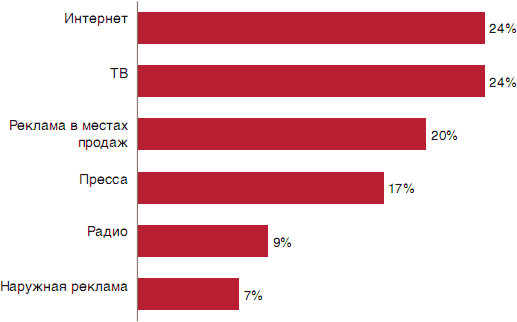
In 2009. 24% of Internet users in France surveyed by IFOP said that they would be influenced by an advert to purchase a product advertised online. The same number of respondents said that television advertising could influence them in a similar way.6 In 2010, eight out of ten Internet users surveyed by Mediametrie reported doing research online before purchasing a product.7
An analysis of the purchasing behaviour of a group of 185 million consumers by market research institute comScore showed the importance of the impact on Internet users of advertising campaigns, which increase online sales by an average of 42% and in-store sales by 10%8.
The study also showed that the value of the average basket of goods of an Internet user who saw an advert was 7% higher than that of a user who did not see it.
Post-hoc tests and econometric models can be used to assess the impact of advertising campaigns on consumer behaviour and purchase volumes.
Post-tests can be used to assess the impact of advertising campaigns on consumer behaviour and offline purchase volumes.
This system makes it possible to evaluate the impact of an advertising campaign in terms of cost, frequency and type of purchase using a specific consumer group as an example. The parameters of the analysis can be precisely calculated so that specific target groups or levels of exposure are the focus, in order to determine how advertising campaigns should be adjusted in the future. In traditional advertising distribution media, post-tests have been used for many years to analyse the impact of Internet campaigns on sales. It should be noted, however, that the impact of the Internet in isolation has never been tested because very few large nationwide advertising campaigns are conducted using the Internet alone.
Econometric models can be used to estimate the impact on sales of online and other multimedia advertising over time, but they require a fairly long observation period.
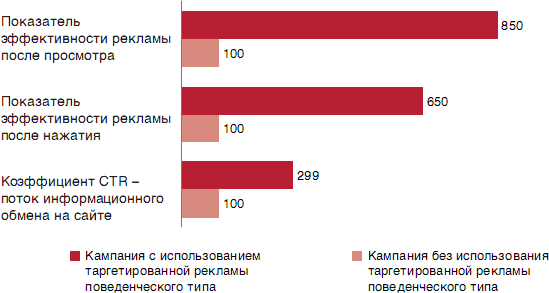
Figure 3: Advertising media with the greatest influence on purchase intentions (% of respondents), France, 2009
Generally, advertisers often use an empirical evaluation method by cross-checking sales data against the strategy of media advertising campaigns. Many advertisers realise that this method needs improvement, as a number of organisational and technical aspects make it difficult to use these indicators.
Make it relevant
If you can't say anything relevant, customers will turn away from you. To keep customers interested and keep them coming back to your website, your social media channels need to be constantly updated with fresh news, content, and new offers.
This means building a social media team to manage the sharing of information and content. Customer feedback and questions about the company's products and services need to be answered quickly if the site wants to avoid a situation where customers give negative feedback or ignore it altogether.
Keep up-to-date
Customers want to receive accurate information about the company they have shown interest in. If you want people to visit your website, make sure that the information you post about your products, activities and promotions is accurate and constantly updated. A social media policy will need to be in place, with risk assessments and control systems in place so that you can manage the relevance of the information posted on your social media sites and respond to the information that (hopefully) your customers will be posting.
ANY QUESTIONS?