


-


-
Statistics
- Are you not bruised? How badly Facebook has suffered since the crash
Are you not bruised? How badly Facebook has suffered since the crash
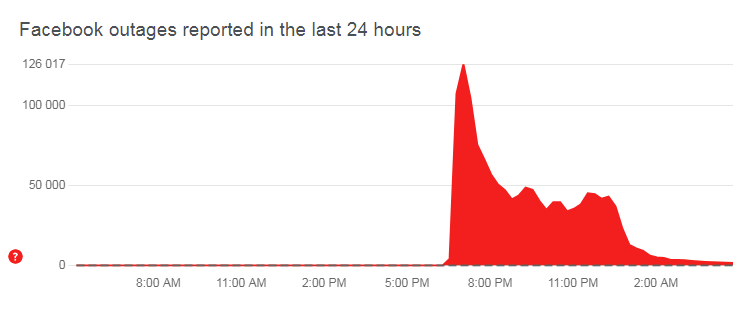
On the 4th of October, Monday evening, users around the world started complaining about malfunctions in Facebook and its owned services WhatsApp and Instagram. This led to Facebook's shares on the Nasdaq stock exchange, and the fortune of the company's founder Mark Zuckerberg decreased by almost $6bn.
During the outage, more than 10.6 million complaints were registered against Instagram, Facebook and WhatsApp, according to Downdetector portal. The main ones are related to the work of the sites and applications of these platforms, as well as connection to the servers. The largest number of complaints came from the US - more than 1.7 million, followed by Germany (1.3 million), the Netherlands (915 thousand), the UK (789 thousand) and Italy (400 thousand). Only after six hours, services began to open for some users.
Facebook acknowledged the problems and apologised to users for the temporary inconvenience. Mark Zuckerberg himself also apologised for the glitch, but did not specify what caused the malfunction. "I apologise for today's outage. I know how much you rely on our services to stay in touch with the people you care about," he wrote on his page. - Sostav portal reported.
Causes of the failure
Experts attribute the possible causes of the failure to internal problems of Facebook. Thus, the journalist of The New York Times reported that Facebook employees can not pass to the company building to assess the scale of the failure in the social network, because their electronic passes stopped working. The Facebook Workplace platform, which the company's employees use for corporate communications, is also reported to have malfunctioned.
Experts interviewed by Kommersant say that the failure occurred due to a change in the configuration of DNS services (domain name system - domain name system, provides a link between the address of the site and its IP) services. Perhaps the company was trying to make some technical updates, but something went wrong. Ivan Begtin, director of the Autonomous Nonprofit Organisation "Digital Culture", notes that this failure once again proved that companies cannot "put all their eggs in one basket": "Although Facebook has repeatedly emphasised the independence of the companies under its control, from a technical point of view we are now seeing the opposite".
The company itself attributed Facebook's failure to changes in the configuration of backbone routers.
Consequences of the failure
Against the background of the incident, the quotes of the company continue to fall. Thus, the cost of Facebook shares fell by 5.34% on the NASDAQ stock exchange. The state of the founder of Facebook Mark Zuckerberg fell by $5.9 billion, follows from the rating Forbes Real-Time, updated in real time.
Among those affected by the incident are also advertisers who expect to be compensated for damages by the US company. "We expect the sites to settle the issue through negotiations, compensate for the lost advertising opportunities and reimburse the losses". At the same time, such failures have a significant impact on the image of advertising platforms: "Users experience inconvenience, technical problems make the audience nervous."
In addition, there was information about a huge leak of personal data of 1.5 billion Facebook users. According to the publication Privacy Affairs, they are sold on a hacker forum. However, the company itself denied this information.
Difficulties with access to Facebook caused malfunctions and other social networks and online services, including Twitter, TikTok, Netflix, Zoom, Tinder, Google and Amazon Viber. The companies said it was a short-term effect caused by the huge influx of users following the "crash" of social networks and messengers Facebook. In particular, Telegram said on Twitter that its servers were experiencing minor difficulties due to the influx of new users after WhatsApp crashed.
ANY QUESTIONS?