



-


-
Statistics
- How Ukrainian business survived the quarantine and lockdown
How Ukrainian business survived the quarantine and lockdown
Since the beginning of the pandemic, Ukrainians have regularly seen in the news reports about a drop in the country's GDP. The main reason is the quarantine, which reduced business activity in Ukraine. A year has already passed, we can summarise the results and see how much this business activity has decreased, and how business in general lived through the turbulent 2020.
The analytical company YouControl has published data on business closures and openings over the past year. And although from the beginning of the quarantine entrepreneurs themselves predicted the closure of more than half of micro and small businesses, in reality everything was not so apocalyptic. Moreover, Ukrainians were not afraid to open new enterprises. Source: Gromadske
What is happening with FLP?
Ukrainians' favourite form of entrepreneurial activity is the physical person-entrepreneur (FLP), so let's start with it. In 2020, 247.5 thousand FLPs were registered in Ukraine, which is almost 5% less than a year earlier.
The most FLPs were registered in February, and the least - in April, that is, immediately after the introduction of the lockdown. Then 8549 entrepreneurs registered, which was the lowest figure for the last 4 years. However, Ukrainians seem to have quickly adapted to the new realities, and the next month there were no such failures.
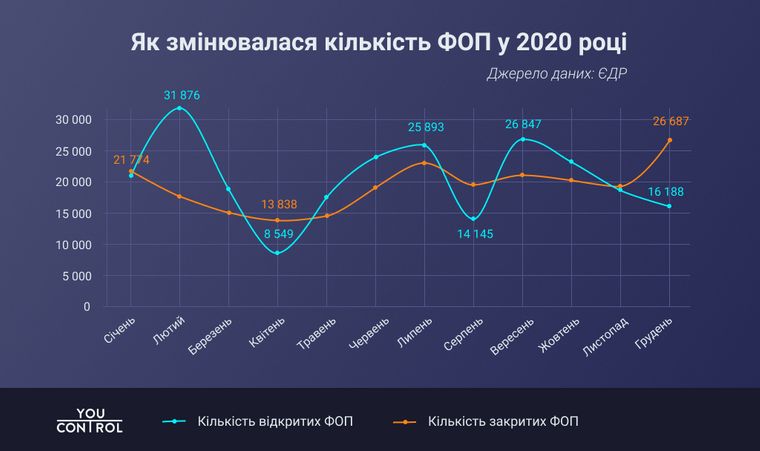
Experts advise to take into account the fact that some areas, on the contrary, have benefited from the "closure" of the country. First of all, we are talking about delivery services, and these companies often register their employees as FLP. This segment was growing before, but last year it developed much more actively
"If in 2017 their share was about 1.3%, in 2019 - more than 5% of retail turnover. For 2020, the total capacity of the food delivery market may reach up to UAH 50 billion," - say the analytical company Pro-Consulting.
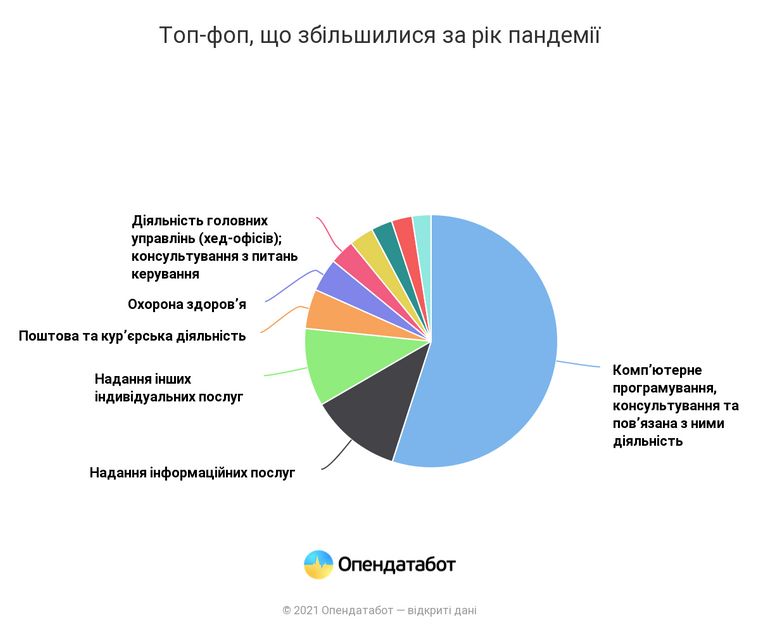
For its part, the company "Opendatabot" has analysed in which areas for the year of the pandemic FLP became more, and in which - less.
This data fits well with the coronavirus realities. Thus, couriers-FLP, which we have already mentioned, became 2.8 thousand, or 353% more. Quantitatively, the most added were "IT workers", who conveniently work remotely.
How many FLPs closed and why?
Compared to 2019, 16% more FLPs closed in 2020 - 232 thousand against 199.8 thousand. About 10% of all closed FLPs were in Kyiv.
Although traditionally December is leading in the number of closures (26.7 thousand), July is almost not lagging behind - more than 23 thousand. YouControl analysts point out that such a delayed dynamics - the impact of the first spring lockdown, because the closing procedure requires time.
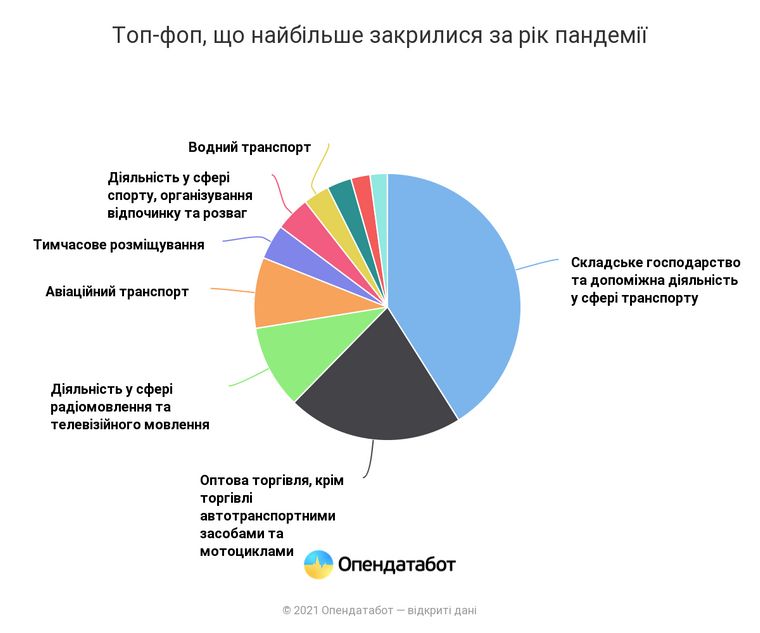
Opendatabot data shows the impact of the pandemic - the areas of air transport and temporary accommodation shrank as people travelled less. And the biggest declines were in warehouse FLPs and wholesale trade.
The tax system has also had an impact: even if the FLP - "sleeping", that is, does not receive income, you still need to pay unified social tax. Its amount depends on the minimum wage, which the authorities have significantly increased. For example, now for one month FLP must pay 1320 hryvnia. Therefore, entrepreneurs and decide to close until "better times" and not pay taxes for the time of "idle".
But not only the lockdown led to the closure of FLP. Last year, entrepreneurs were expecting a number of legislative innovations, which they perceive extremely painful - the introduction of cash registers and the obligation to provide documentation for all goods. Eventually these requirements were postponed, but they did so only in December.
As a result, we can say that the drop due to quarantine was far from what entrepreneurs themselves expected (that more than 50% will close). And almost 2 million active FLPs as of the beginning of 2021 do not allow us to talk about the crisis of small business.
What about other businesses?
According to YouControl, in pre-quarantine 2019 in Ukraine registered 67.5 thousand new legal entities, and in 2020 - about 54 thousand, that is less by 20%.
Most of all new enterprises opened in the capital - more than 15.5 thousand. Next with a serious gap are "traditional business centres" Dnipropetrovsk, Odessa, Lviv, Kharkiv and Kyiv regions. Almost 18 thousand enterprises were registered in these regions. The outsider was Lugansk region - less than 500.
By a large margin, the popular industries were "complex maintenance of facilities" and "non-specialised wholesale trade" - 3,481 and 3,243 respectively.
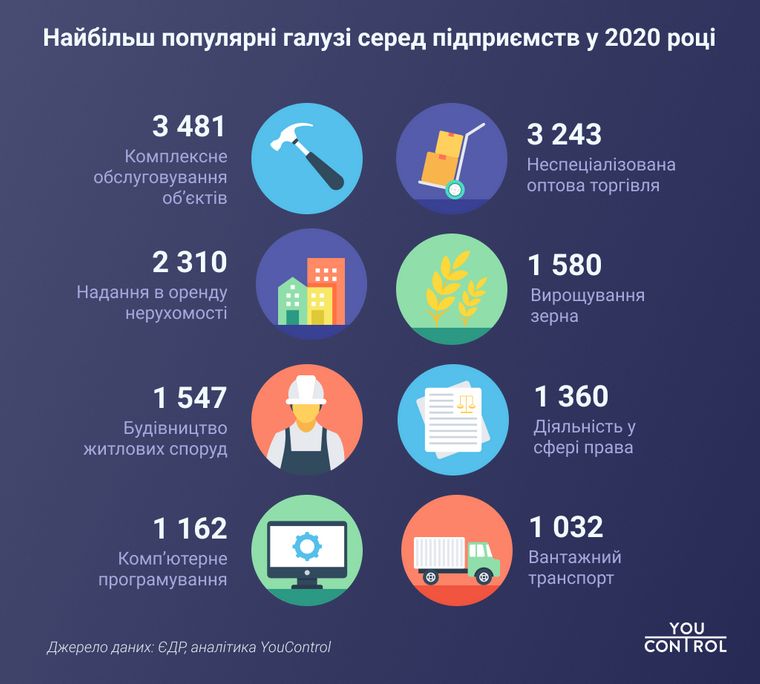
If we take all wholesale trade (that is, specialised and non-specialised), it has been among the leaders for a year - in 2016-2018, the share of such business grew from 25% to 33%. But in 2020, the percentage dropped to almost 20. Above we have already mentioned that among FLPs, too, the share of wholesale trade has decreased.
"Experts note that this may have been influenced by the coronavirus restrictions, when business was not sure of a guaranteed market entry. In this regard, it chose less dynamic, and therefore less quarantine-dependent spheres of business activity. In particular, trucking, logistics, property rental and construction," YouControl says.
Despite the negative expectations, just over 10 thousand businesses closed in the crisis year 2020 - a third less than in the pre-crisis year 2019.
The European Business Association also describes the situation as tense, with the biggest losses being experienced by those who have failed to adapt.
"Losses will be in the tourism business, because tourism will continue to be limited. In addition, the restaurant business, the beauty sector - hairdressers, stylists, etc. will also suffer. But IT, pharmaceuticals, logistics will feel better," says Anna Derevyanko, Executive Director of the EBA.
Despite the differences by sector, she notes that for business in general, the main issue now is the purchasing power of the population, because if employment falls, it affects people's spending.
"In general, EBA member companies are cautiously optimistic because many have adapted during the first lockdowns and will try to keep their jobs going forward. But, of course, this is not all businesses in the country," Derevyanko noted.
She believes that the state should more actively help small business, which suffers most during the pandemic, and here 8 thousand hryvnias of assistance is not enough.
As for big business, the consulting group One Philosophy surveyed 50 business owners and managers in October. As a result, 45% said that in 2020 the income of organisations will fall by 20-90%, so 39% of companies gave up part of the office or agreed to revise the terms of lease, and 61% - were forced to reduce wages.
At the same time, the authors of the study point out that the pandemic has accelerated the implementation of changes. For example, 71% of respondents said they had launched a new product or service, and 55% had brought in new partners for joint initiatives.
And although a year has already passed since the beginning of quarantine in Ukraine, and business has obviously adapted to such conditions, one should not relax. The pace of the epidemic in the country is rapidly gaining momentum and a new lockdown is already looming on the horizon. So the year is new, but the extraordinary conditions in which we have to live are still old.
ANY QUESTIONS?