



-


-
Statistics
- What language do you google in? Internet user statistics by language
What language do you google in? Internet user statistics by language
Online search analysis, languages on the Internet, what language is best to create a websiteSlightly more than half of websites and web pages on the Internet still use English as their primary language, but its share is on a gradual decline due to the faster growth of Internet segments in other languages. According to a study conducted by W3Techs, the share of English from April 2011 to November 2017 across all websites worldwide fell from 57.6 per cent to 51.2 per cent. Other languages used on at least 2.0 per cent of sites are Russian, German, Japanese, Spanish, Chinese, French, Italian, Portuguese and Spanish. According to W3Techs research, in March 2013 Russian became the 2nd most used language on the Internet, surpassing German, and since then it has continued its gradual progressive growth. From March 2013 to December 2017, the share of Russian on Internet sites increased from 5.9 per cent to 6.8 per cent (mainly due to the growth of small traffic sites in Russian). 89.8 % of .ru and 88.7 % of .su sites operate in Russian. In 2013, 79.0 per cent of websites in Ukraine, 86.9 per cent in Belarus, 84.0 per cent in Kazakhstan, 79.6 per cent in Uzbekistan, 75.9 per cent in Kyrgyzstan and 81.8 per cent in Tajikistan were also in Russian. Of the 1,000 most visited websites in the world in 2013, 6 had predominantly Russian content.
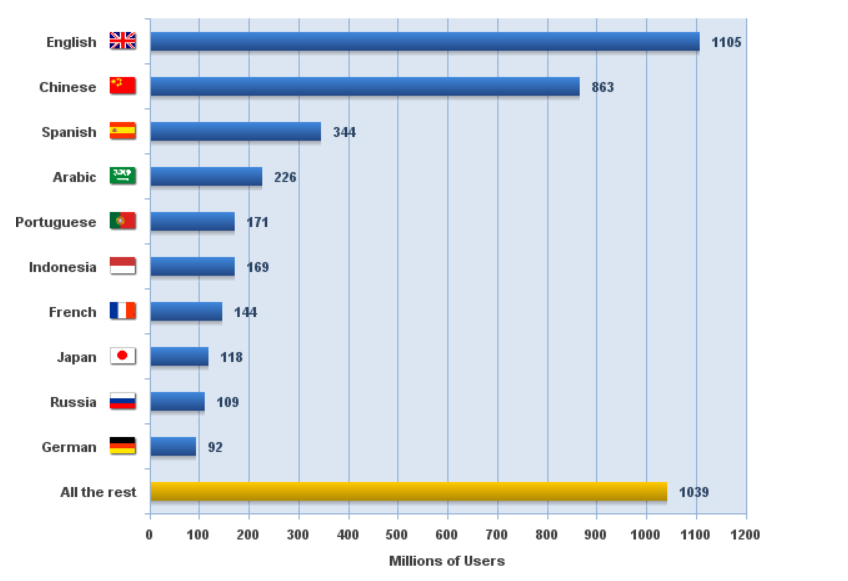
Below is a detailed table of the top ten most spoken languages on the internet by number of speakers as of 2019.
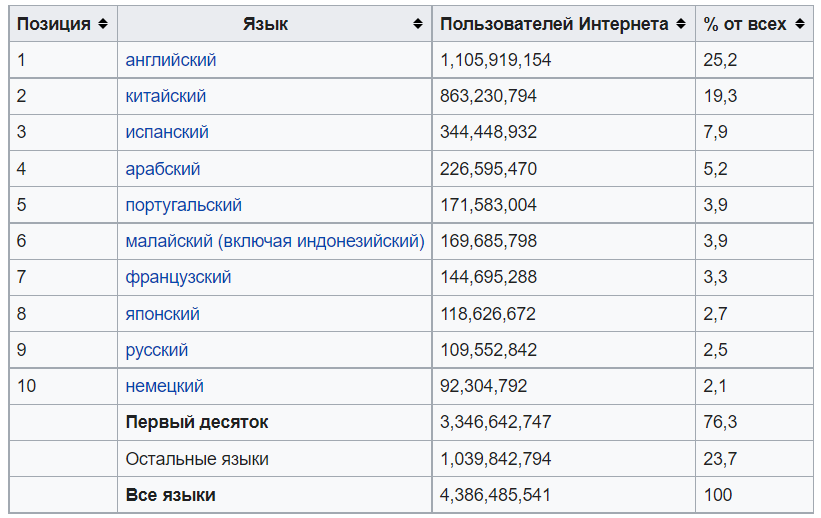
All other languages are used on less than 0.1% of websites. The statistical count, however, is also complicated by the growing multilingualism of websites and even pages. The penetration of the Internet, the level of education, the degree of real urbanisation and post-industrialisation of certain communities undoubtedly contribute to the dynamics of the use of certain languages on the Internet, causing strong disparities. For example, there are significantly more sites in Russian (6.7 per cent) than in Spanish (5.1 per cent), even though there are at least twice as many Spanish-speakers as Russian-speakers in the world. And the share of Chinese-language sites (2.0 per cent) in 2017 was almost identical to their share in Polish (1.7 per cent), even though there are almost 40 times as many Sinophones as Poles in the world. Source: Wikipedia. Due to the traditional preference for English in British India, Hindi (the second most spoken native language in the world after Chinese) is still very underutilised on the internet and any move to promote the second most spoken language in the world of technology is yet to be seen. Very well-known or numerous modern state languages such as Albanian, Armenian, Afrikaans, Tagalog, Kazakh, Uzbek, Bengali, Mongolian, Urdu, Swahili, Tajik, Malay, etc. are still hardly used in the creation of Internet content.
Below is a detailed table of the dynamics of languages used on websites 2011-2019.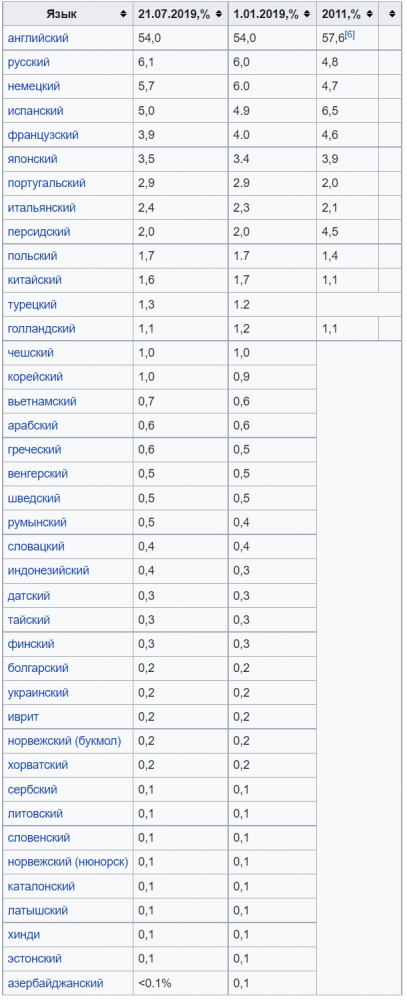
ANY QUESTIONS?