



-


-
Business solutions
- 10 myths about SEO that you can safely ignore
10 myths about SEO that you can safely ignore
Let's debunk some common myths about search engine optimisation once and for all.
- Search engine optimisation is outdated
This is more nonsense than a myth, but nevertheless it is worth dispelling.
Buzzword-hungry journalists regularly proclaim the death of one phenomenon or another, and search engine optimisation (SEO) is no exception. According to data from June 2016, the phrase "SEO is dead" was expressed on the Internet 3367 times.
That's an average of 66 times per month.
So let's set the record straight on this issue:
SEO. OPTIMISATION. NOT. OUTDATED.
So how can it be argued that SEO is obsolete?
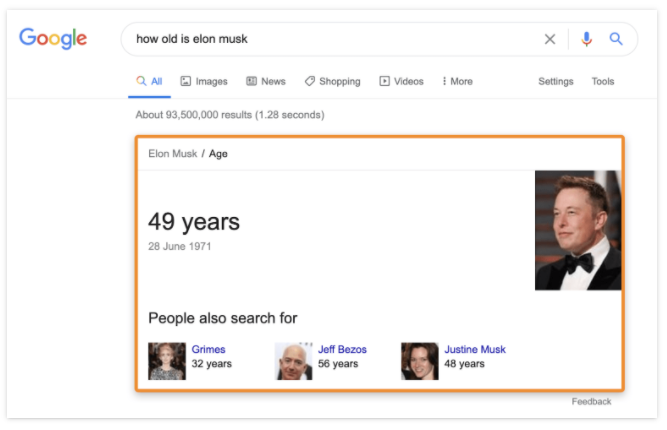
There are many different reasons, but the most common argument being made right now has to do with the increasing prevalence of these direct answers in search results:
Are the number of page conversions in search results decreasing because of them? Absolutely. If we look at the query from the screenshot above, we see that at 14,000 queries per month, the number of click-throughs to search results is only 1,200. That is, 8% of the total number.
But that doesn't mean that SEO is no longer needed. There are still conversions for this keyword phrase, and not all keyword phrases are directly answered by Google.
As long as search engines exist, are used, and show natural results that you can influence in any way, SEO cannot be called obsolete.
- Search engine optimisation is a one-off event
Search engine optimisation is like going to the gym. It's okay if you skip a workout or two, but if you stay home too often cuddled up with chips, it's going to go to waste pretty soon.
This is what happens when you stop optimising:
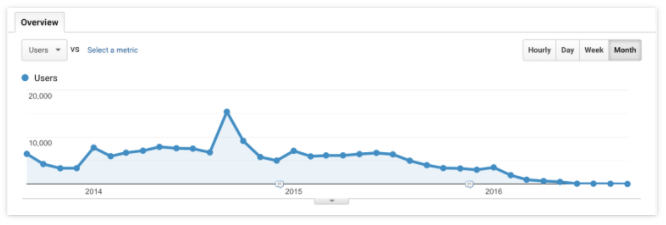
Before the period given here, the site was being actively optimised. Then you abandoned it and turned your attention to other things. As you can see, traffic gradually declined over the following months.
There are several reasons for this:
Competitors are outranking you by consistently working on optimising their pages.
You start losing backlinks due to their "fading".
Your content loses its "freshness" (more on this a bit below).
This is why most SEO professionals (74.71%) charge a monthly fee for their services rather than an hourly or one-time fee. They know that SEO is a process that needs to be constantly maintained, and clients need to invest in long-term work to see the results they want.
Is this true for all websites without exception? No. There are rare cases where work in this vein on a site stops, yet it continues to get consistent traffic month after month.
3- Google only shows "fresh" content in the first results
"Freshness" is a ranking factor that depends on the query. This means that some queries are more affected by it than others. It all depends on whether the freshness of the content affects its quality.
SEO is constantly evolving, so for related queries, freshness is very important.
On the other hand, freshness doesn't play a big role for queries like "how to tie a tie" because that process doesn't change over time. This is why Google gives the top three results for pages that were last updated in 2013.
- Long-tail keyword phrases are easier to get to the top of the results
Many people think that long-tail keyword phrases are phrases that have a lot of words in them, but that's not really true. Long-tail keyword phrases are phrases with low individual query volume. The number of words doesn't matter here.
But here's the thing: even though long-tail key phrases don't get very many queries per month, they are usually no easier to get to the top than their more popular counterparts.
Despite the significant difference in the monthly volume of queries, the values are about the same. That's because low search volume queries are what we call "long-tail auxiliary keyword phrases." In other words, they're simply less popular formulations of a popular topic.
And it's not easier to get a page on them to the top, because Google gives in this case almost the same set of results as for the "main" keyword phrase.
To be fair, there is another type of key phrases "with a long tail", for which this task is solved more easily. We call them "thematic".
5. Duplicate content is penalised
Duplicate content occurs when completely or nearly identical content is posted in more than one place. Duplicate content can occur on the same site or on different sites.
Duplicate content occurs when completely or nearly identical content is posted in more than one location. Duplication can occur on the same site or on different sites. Google has stated many times that duplicate content is not penalised in any way, but the myth to the contrary still pops up online time after time.
However, even though duplicate content is not penalised in any way by search engines, it still causes SEO problems such as:
Unwanted or unfriendly addresses in search results.
Reduced weighting of backlinks due to being split between addresses.
Waste of crawling budget.
Showing copied or syndicated content above the original content in search results.
- Social media related signals help to increase prominence in search engine results positions
It wouldn't be wrong to assume that the higher the number of reposts of your content on sites like Facebook, Twitter and Pinterest, the higher its ranking in the results should be. After all, if a lot of people are sharing something, that "something" must be interesting, valuable and worthy of a high ranking.
Probably all because social media signals are amazingly easy to manipulate. Seriously, look at Fiverr. You can get thousands of signals for a few dollars.
But if that's the case, why do so many studies show a correlation between reposts and prominence position?
There's no clear explanation for this. But in our opinion, there's a combination of two main factors at work here:
Social media reposts get content to more people, and this leads to more backlinks (which is already a ranking factor).
Pages that are ranked high on Google get more traffic, and some of the visitors repost their content on social media.
- Contextual advertising does not help to increase the positions in the rendition
Let's be clear: paying for advertising in Google does not directly affect the positions in rendition. We're no stranger to conspiracy theories, but Google doesn't boost your positions just because you pay for advertising.
However, that doesn't mean that contextual advertising can't indirectly boost your positions.
After all, it gives you the opportunity to attract backlinks.
But that doesn't mean that you can run any old advertising campaign and just watch the backlinks rain down on you. It takes a certain approach.
- PageRank doesn't matter anymore
PageRank is a Google mainstay. It evaluates a page based on the quantity and quality of backlinks.
In 2018, Google confirmed that PageRank is still a ranking factor.
But ever since Google stopped showing the value of PageRank openly in 2016, some have started to believe that it's no longer worth talking about this metric in the context of SEO:
Of course, there's logic to that argument. After all, what good is it to talk about a metric that we no longer see. But the fact is that PageRank is still a ranking signal; which means that getting quality links to pages still matters for search engine optimisation.
- The essence of SEO is to increase search engine ranking positions
Everyone would like to be ranked first, because we assume that the first result brings the most traffic. But this is not always true. Our study of 100,000 search queries shows that the first result in an issue gets the most search traffic only 49% of the time.
Why? Because most pages get traffic for multiple keyword phrases, not just one.
This means that it's time to stop fighting for the first result spots and instead focus on traffic.
The basic principles are as follows:
Go in-depth on your topic.
Build up the number of backlinks to increase the "authority" of the page.
Match the intent of the queries.
- Key phrase analysis is unnecessary
Given that most pages are ranked in the top of the results for hundreds or thousands of key phrases, it's easy to see why some people think that keyphrase analysis is unnecessary. What's the point of optimising for one keyphrase if you're going to get traffic from hundreds of them?
This logic is pretty terrible, as the popularity of a keyword phrase usually corresponds to the overall search traffic potential for the topic.
Key phrase analysis also helps to ensure that you are optimising for the most popular wording of the topic. This is very important if you want to attract the maximum amount of natural traffic to your page.
TOTALS.
These are just some of the most common SEO myths that we come across all the time, which we have finally decided to put to rest.
Don't be fooled by populists and misinformers, choose quality - choose AVSEO!ANY QUESTIONS?