



-


-
Business solutions
- "People also search" blocks, and whether or not you should rank in them
"People also search" blocks, and whether or not you should rank in them
43% of all search queries now show a PAA block
How you can rank for PAA blocks, whether you should even pay attention to them, and other ways they can help your SEO.
What is a People Also Searching (PAA) block?
A People Also Searching (PAA) block is a search engine feature that answers questions related to a user's query. Each answer is excerpted from the web page, and Google provides clickable source links under each one.
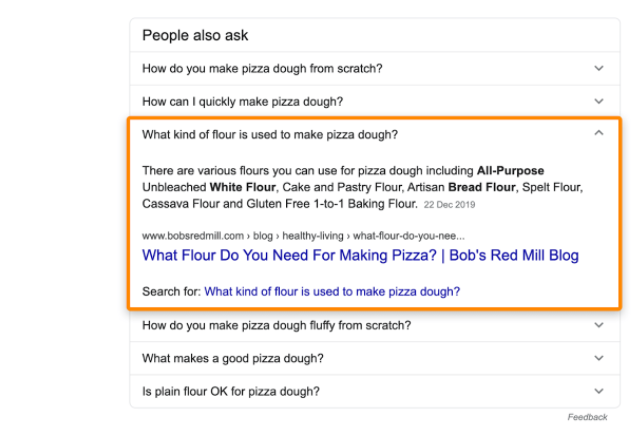
Four facts about People Are Also Searching (PAA) blocks
Before we talk about whether and how you should be ranking for PAAs, let's go over a few things to keep in mind.
PAA blocks can appear in different places in the issue
Unlike answer blocks, which usually appear either first or second in search results, PAA blocks can seemingly appear anywhere.
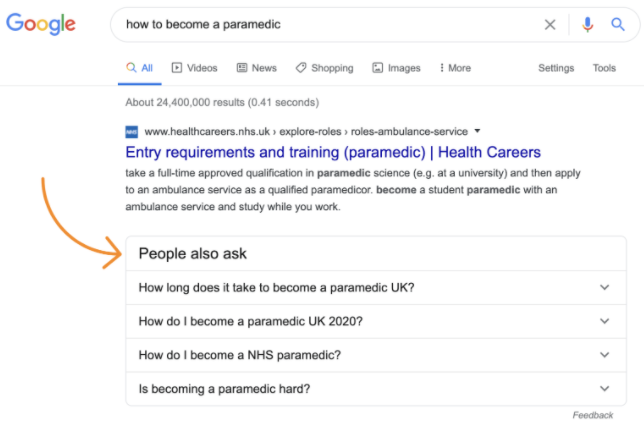
For example, for the query "how to become a paramedic" it appears in the second position:
And for the query "blog post templates" it only appears in the 6th position.
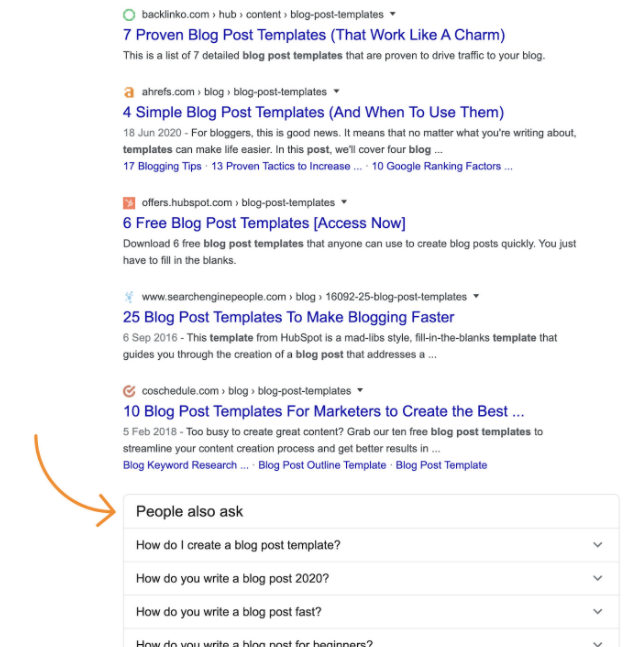
For some queries, the PAA block doesn't even appear on the first page.
The questions in the PAA block seem endless
More questions load as you unfollow the answers in the PAA block. And if you click and click and click, there seems to be no end to them.
The format of the answers in the PAA block varies
As in answer blocks, answers to similar questions in PAA blocks occur in different formats. Paragraphs, lists, and tables seem to be the most common, but videos sometimes appear as well.

Questions in a PAA block always* elicit the same answer
Although the same questions often appear in PAA blocks for multiple search queries, Google seems to use the same source for the answer every time.
For example, "What is the most searched thing on Google ever?" (what is the most searched thing on Google ever?) appears in the PAA block for queries like "google trend searches" and "how many searches on google". And the answer is pulled from the same source in both cases.
* Having checked enough answers during the research for this article, we couldn't find a single case where it was different. If Google gets an answer to a question from your page once, it will pull that answer from your page every time the same question comes up.
Is it worth trying to rank for "People Also Searching" (PAA) blocks?
Unfortunately, there is very little available data on how often people interact with and click on sources in PAA blocks. Most likely because Google doesn't show this data in Google Search Console, and we don't have any other reliable sources.
In fact, the only independent study I'm aware of is the Backlinko study. It states that on average, only 3% of searchers interact with the PAA block.
Only 3% of Google users interact with the People Also Searching (PAA) block
But it also notes there that this number varies a lot, and some queries can get even 13.6% interaction.
And remember: interactions and clicks are not the same thing. Unfollowing a response counts as an interaction, so the number of people who do click on the response source is likely to be much lower.
Worse, most PAA blocks default to showing 3-4 responses, creating more choice for users and more competition for web pages.
Still, let's be moderately optimistic and make the following assumptions:
3% interaction rate on average.
40% of all interactions result in clicks on the source.
Interactions are evenly distributed among the four questions (i.e. 25% each).
Let's do the math and get that 0.3% of searches with a PAA block result in clicks. In other words, to get 100 additional clicks from the PAA block, you would need to appear as a source in a question that shows up for a keyword with a cumulative monthly search frequency of about 33,000.
This may sound discouraging, but there are a few things to keep in mind:
Google often shows the same question in the PAA block for hundreds of queries. And because it always pulls the answer from the same source, showing up for keywords with the desired aggregate search frequency is much easier than it sounds.
Google can use your page as a source for multiple answers. For example, in cases where your page answers many common questions. If Google shows these questions for many search queries, the number of views and clicks can gradually increase.
It's also worth remembering that traffic isn't everything. 50 or 100 extra clicks on a page with a high conversion rate or value per visitor could significantly boost your financial performance.
In my opinion, then, optimising for PAA blocks can be useful for pages with high traffic volume or high value.
How to rank for People Are Also Searching (PAA) blocks
The basic process is simple: find a relevant question in a PAA block, then perform on-page optimisation to increase the likelihood that Google will use your page as a source for the answer.
However, choosing questions to optimise at random is not effective. After all, the question may only appear in the PAA block for a couple of low-frequency queries. In that case, ranking there won't increase traffic for you (or you won't appear in the block often enough). Instead, it's more useful for you to optimise for relevant questions that show up for many keywords with high overall monthly search frequency.
But how do you find popular questions? And how do you optimise for them?
The process is as follows.
Find pages that rank for many keywords
Pull their keyword positions
Extract questions from the PAA blocks
Identify popular questions
Make sure you are not already a source
Check if you are suitable for ranking
Optimise your page
Does your page have the answer to the question?
If your page doesn't have the answer, you need to add it. After all, there is no chance that your page will be selected as an answer source if it is not actually a source.
However, there is no need for the question to be exactly the same on the page.
For example, Healthline is the answer source for the question "What is a dehumidifier used for?"
But the page itself doesn't use that wording. Google pulls the answer from the intro under H1, which says "What Does a Dehumidifier Do?"
It's also important not to cram answers to irrelevant questions into your content. For example, if your page is about the top 100 most visited websites, trying to optimise it for the question in the PAA block "what is a website?" is a bad idea. - is a bad idea.
Is it in the format Google expects to see?
Like answer blocks, answers in a PAA block come in a variety of formats. Text, tables, lists and videos are the most common. You can check what format Google expects to see by looking at an existing answer to a question.
For example, it's clear that Google expects to see an unnumbered list for the question "What is the best accounting system for a small business?"
If your content doesn't meet this format, it is unlikely to be selected as an answer source. You can change the format of your content to fit the expectations. Plus, it will often make your content more appealing to other visitors.
Is the code clean?
Confusing code often confuses Google, so it makes sense to make it as clear as possible. This means using clear headings (H2, H3, etc) and removing unnecessary rubbish.
For example, if we wanted Google to retrieve the answer to the question "How do I become an affiliate marketer?" ("how do I become an affiliate marketer?") from this post, it might be worth summarising the main points from the seven steps listed immediately afterwards.
People also often speculate that marking up your questions and answers with Schema could improve your chances for appearing on PAA blocks. It's not a requirement, but it certainly seems logical that it would help as it would make it easier for Google to extract relevant information.
How else can you use PAA blocks to improve SEO
Ranking in common PAA blocks isn't the only way you can use them for SEO.
Content Improvement
PAA blocks often provide insights into related things users want to know about. Incorporating these answers into your content can help make your content more meaningful, as well as better meet the user's search intent.
For example, take a look at the PAA block on "guest blogging". All the things users might reasonably expect to know when they click on a result are there, and yet our post doesn't answer any of those questions. Perhaps that's why it only ranks at position 12, despite having more backlinks than many of the pages above it.
Finding new targeted keywords
Most issues that show up in PAA blocks seem to rarely have a high monthly search frequency.
But that doesn't mean that people aren't searching for answers to these questions in other ways.
For example, if we set up an Ahrefs SEO toolbar and search for some questions, we can see that pages ranking at the top get about 4,800 search hits per month.
That's because the page is getting traffic from a lot of other similar keywords like "new airpods" and "airpod 3".
In this case, you would most likely find these keywords by following the traditional keyword research process. But if you continue to further drill down into PAA blocks, you'll likely end up finding questions related to topics you never even considered writing about.
Providing better answers to branded queries
Branded queries are usually low-frequency queries, but the people who search on them are closer to the neck of the marketing funnel and close to conversion. If they receive misleading or inaccurate information at this stage, it can easily lead them to abandon a purchase.
Ranking in PAA blocks can no doubt increase organic traffic, but you need to be sensible about what to fight for. There's no point in optimising for an issue that only appears occasionally for low frequency keywords.
ANY QUESTIONS?