



-


-
Business solutions
- How to promote a blog, tips from professionals
How to promote a blog, tips from professionals
Have you just published a blog post but don't know how to promote it?
The strategies we are going to talk about below are enough to promote your blog.
Let me reassure you.
In blogging, we have worked with different topics:
blogs for SaaS tools
web design blogs
photography blogs
blogs created for the Amazon affiliate programme
personal blogs
etc.
So we're 100% sure that the strategies we'll talk about next will work great for your blog.
The subheadings may look simple and obvious, but we bet you'll be surprised by what's written underneath.
Run Facebook adverts
Don't tell me you don't have the money to promote. If you don't spend money, you'll have to spend time.
Let's explain with an example.
Imagine that you have chosen "marketing on Quora" as your promotion strategy. You need to:
Find relevant topics on Quora where you can talk about your articles;
Write extended responses (so moderators don't delete them);
Leave links to articles from your blog in your replies.
Now leave at least ten helpful responses on Quora and in each one, insert a link to your blog posts. We'll wait for you to finish.
...
Did you do it? Of course you haven't. Because it can easily take you more than two hours to write ten quality answers on Quora.
How much do you think your time is worth? A simple search for "copywriting" on UpWork shows an average rate of $50 per hour.
But even if you estimate yourself at a modest $15 per hour, it's still worth the money ($30) for two hours of your time.
See where we're going with this?
Most people want to learn about "free content promotion strategies" because they don't want to pay for promotion. But what they often don't realise is that there really isn't a free method. That's because there are opportunity costs.
An opportunity cost is an economic term that refers to the opportunity cost of choosing one alternative use of resources and thereby foregoing other opportunities.
In our example, the opportunity cost is $30 ㅡ the money you would have earned by spending those two hours on paid work.
Now back to Facebook advertising.
We can get clicks from Facebook for less than 30 cents. That means that for $30 you can get over 100 guaranteed clicks on an article.
How many clicks do you think you'll get from those ten responses on Quora?
It's roulette. It could be 10. Or maybe 500. Or maybe ㅡ zero.
We can tell you from experience: to get at least 100 clicks by the end of the month, you need to spend at least 5 hours every week. Now let's calculate:
5 (hours per week) * 4.35 (weeks per month on average) * $15 (estimated salary per hour) = $326.25 (for 100 clicks from Quora).
It's up to you to decide if you want to waste your time trying to get traffic from Quora (or using any other "free" promotion methods), or would you rather invest some money in Facebook Ads and spend your precious work hours on something more useful?
Our goal is to demonstrate that you DO have the budget to promote with Facebook Ads, because it will free up some time that would be better spent on something else.
If you can't budget $30 to promote an article, how can you even justify the countless hours spent writing it?
We at AVSEO have a set of articles that consistently get cheap clicks from "cold audiences" on Facebook. Instead of allocating a fixed one-time budget to promote these articles, we allocate a small amount each month to show the articles to more and more readers.
We keep an eye on the frequency of Adverts so that we don't show the same article more than three times to the same people.
Promoting to an existing audience
This is a trap!
We see too many bloggers and businesses limit promotion to working with their existing audience.
If that's all you're doing to promote content, you won't get very far.
For example, with Facebook ads, you can easily exclude those who have already read the article from your audience and only pay for clicks from people who didn't know about you before.
This way you can effectively grow your audience and show your content to more and more users.
What happens when you only send out an article to your existing subscriber base, or only to subscribers on Twitter, Facebook or LinkedIn?
You bring the same people to the site over and over (and over) again!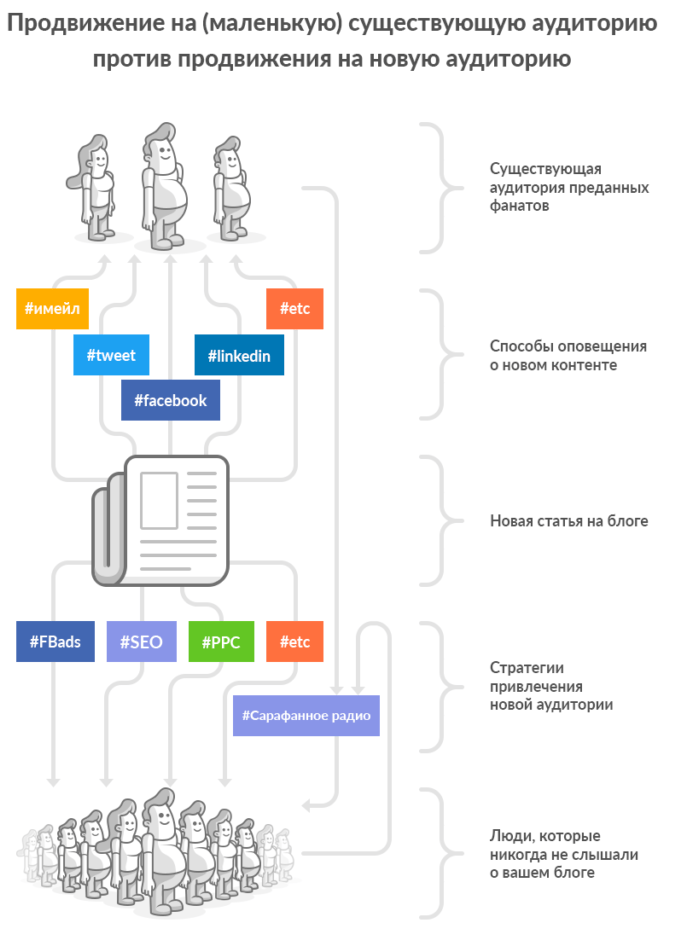
But is that a problem? After all, an existing audience will help spread the content (via tweets, reposts, in posts, etc.) and more people will see it, right? Not really.
Firstly - if you already had a large audience, you wouldn't be reading our blog promotion article right now.
Secondly - the number of visitors from email newsletters or from Twitter and Facebook followers is fickle. Because you are unlikely to get at least 30% of all subscribers to your new article.
Third - most people who go to an article don't read it to the end. Let alone share it on Twitter or send it to their friends. To get this effect, the article must be of exceptional quality.
In other words, it is very difficult to get a tangible influx of traffic through word of mouth alone.
Always promote a new blog post to your existing audience. Some of your fans can really help promote by retweeting and sharing the post with friends.
But don't kid yourself. Not all of your subscribers will do this. Most won't.
Create content that people will want to share
We wanted to start this article with this method, but we were afraid you'd roll your eyes and close it right away. We're sure you're tired of the same advice like "create quality content."
But since you've already read about the previous two methods, we hope you'll let us elaborate on this one.
Creating good content that people will want to share is critical to the success of a blog.
Surprise your readers;
Give them more useful content than they expect;
Stir up their emotions ....
... and they'll be talking about you everywhere!
In other words, creating top-notch content is the most important content promotion strategy.
A great way to gather awesome ideas for your blog is to find out which competitors' articles attracted the most backlinks. To do this, enter your competitor's URL into SiteExplorers and go to the best pages by links report.
When you look at which articles have the most links from other sites (Referring Domains), it's obvious that our detailed guides and research are the most successful.
Test this report on your competitors to see what works for them.
The best strategy to promote a blog is to turn readers into live ads. Make people talk about it at every opportunity.
If the content is good enough to share, there's a good chance that every visitor you attract (from Facebook ads, Quora answers, SEO or wherever) will tell their friends about it, which can end up having a small "viral effect".

Keep in mind that a lack of copywriting skills can put a damper on even the coolest article idea.
If you want to surprise people with content, you need to learn how to write well.
But honestly, people won't share content just because it's original.
Great content ≠ reposts
You may need to study the psychology of user interaction with content to understand how to create content that is willingly shared.
Get traffic from Google
More often than not, traffic to a new blog post will look like this:
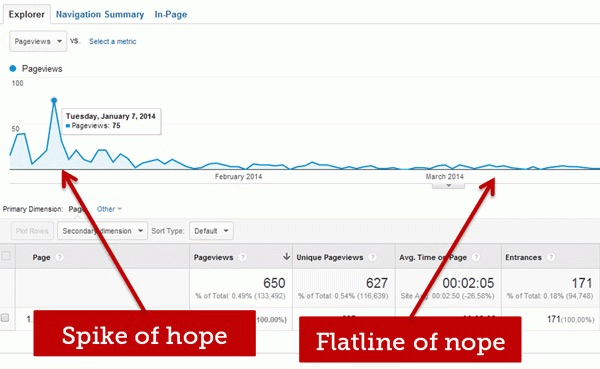
Let's break it down in order:
You send out a new article to your subscriber base and post it on social media to get the first influx of visitors;
Then your audience spreads the article a little further by sharing it with friends and colleagues;
Then you throw some money at Facebook ads to attract a new audience.
What's next?
Your existing audience has already seen the article;
Their friends have too;
And your Facebook budget has run out.
Does that mean no one else will ever read the article again?
Not if it ranks in Google:
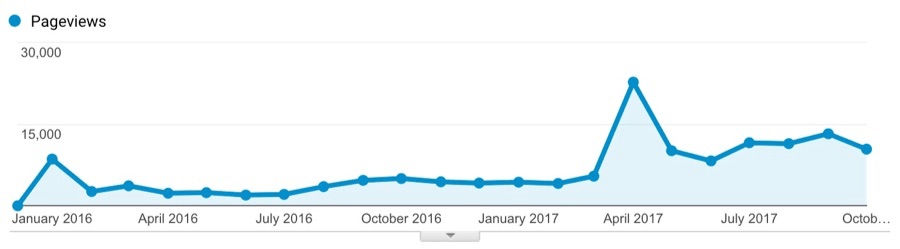
You can see that the traffic to the article didn't disappear after the initial spike. It continued to grow. Then we completely rewrote and relaunched the article in April 2017, which helped increase traffic even more.
Here's the power of SEO.
If you've been blogging for about a year or longer, chances are some of your articles are already ranking in Google and getting a steady influx of traffic every month.
That's a good thing. But if you're not directing traffic deep into your blog, you're missing out on additional opportunities.
When we publish a new blog post, we often go back to see if we can put internal links to it from other, older posts. We do this because Google loves it when a page has relevant links to it from other, older pages.
It's also a great way to direct search traffic from older articles to newer ones.
Where to start optimising?
It all comes down to three basic points:
Understand what your ideal blog reader is interested in (i.e. what they would search for on Google)
Write an article on that topic and make sure it's the best of its kind
Get links to the article from other sites.
It's simple enough.
Some bloggers know their audience so well that they don't even need to look for keywords for new articles. And they don't have to worry about linkbuilding because they have enough fans in the industry who will gladly link to a new article.
But if you're not one of those lucky people who gets SEO on your own, you'll have to spend some time learning about SEO and content marketing.
AVSEO is always ready to lend you a helping hand and teach you all the SEO tips and tricks of the search engine optimisation world.
ANY QUESTIONS?