



-


-
Business solutions
- How to increase the authority of a website/domain?
How to increase the authority of a website/domain?
But the truth is, while it never hurts to increase a site's authority, it shouldn't be your main goal in and of itself.
The goal should be what leads to higher rankings - quality backlinks from authoritative sites.
Site authority is a metric that can be found out using search engine optimisation tools. It shows the relative prestige of a site's backlinks compared to all other sites in the index.
Almost every serious SEO tool has this indicator, although it can be called and calculated differently.
Like most other indicators of authority, it is evaluated on a scale from 0 to 100.
It is important to understand that a logarithmic scale is used to evaluate the domain rating. This means that it is much more difficult to increase the rating from 69 to 70 than from 9 to 10.
To better understand, think of it as an analogy to ranking in a video game.
You can start as a "beginner" and earn the "experienced" badge in a few hours. But moving to the next level can take months, and only the most diligent players will ever reach the rank of "master".
Also, the logarithmic scale means that a site with a DR of 20 is about twice as "authoritative" as a site with a DR of 10.
Before taking to increase the authority of the site, it does not hurt to understand how the domain rating is calculated.
The number of sites linking to your site
We at AVSEO use the term "donor domains". This is the number of other sites that link to your page or site.
You can find out this number for any site in Site Explorer.
Some people think that the higher this number is, the higher the domain ranking. But it's not that simple, as only follow-links are taken into account when calculating DR. Links with UGC, sponsored and nofollow attributes will not improve DR.
A lot of links from one site also will not improve the ranking, because the account are donor domains, not backlinks.
Anyone can get thousands of links from many third-rate sites. That's why when calculating DR, we also take into account the DR score of the linking sites.
In other words, backlinks from high DR sites boost your domain ranking more than links from low DR sites.
This is a curious point. It means that as the donor site's ranking goes up, so does your ranking.
For example, if now you get a link from a site with DR 15, and the owner of this site is working hard on linkbuilding and increasing authority, then after a while the same link may lead from a site with DR 40. So your domain ranking can increase over time, even if you only got one of those links.
The conclusion is that getting links from sites that show potential pays off, even if their current ranking is quite low.
How do you evaluate this "potential"?
Firstly, look at the content on the site of interest. If the site publishes quality content, it is likely that over time it will naturally attract quality links.
Secondly, check the link growth dynamics in Ahrefs' Site Explorer. If the graph of the number of donor domains is growing smoothly and steadily, it is likely that this will continue to be the case, and the domain ranking will increase over time.
Number of sites each donor domain links to
Let's say you get two follow-links: one from The Guardian newspaper website and one from the IMDB film database website. These sites have the same DR rankings - so which link will have a stronger impact on your domain ranking?
Answer: it depends on the number of sites to which at least one follow-link leads from the donor site. The more unique sites our site links to, the less "DR weight" each link conveys.
The Guardian links to over 50 times more sites than IMDB (272,218 vs. 5,256). This means that a link from IMDB will boost your domain ranking more strongly than a similar link from The Guardian.
You need to keep in mind that all of the above does not make links from IMDB more "authoritative" than links from The Guardian. There are many other factors that make a backlink good.
How to increase your domain ranking
Attract more follow-alikes to your site and your domain ranking will go up. That's it. Just keep in mind that if the site from which the link is coming from has a low ranking itself or links to a lot of sites, the increase in domain ranking from it will be negligible.
It is also important to realise that building links to random pages will not always help you increase your rankings or natural traffic. And since your ultimate goal is probably just that, you should focus on building links to the exact pages whose Google positions you want to improve. This will have a stronger impact on natural traffic and rankings than simply "boosting DR".
We at AVSEO say this based on our own research. The number of page donor domains correlates much more closely with natural traffic than domain ranking.
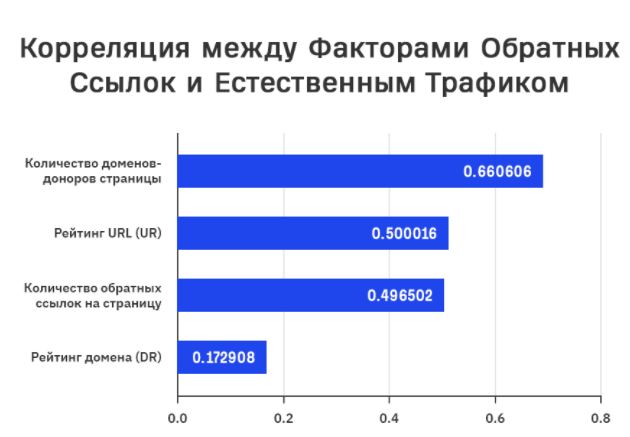
Of course, it can be difficult to attract links to a page that you want to get to the top of Google.
For example, it can be difficult for a printing company to encourage people to link to a page that sells business cards because there's little incentive to do so. So, if you're in a quandary....
Here's how to boost your site's authority so it's "meaningful."
Create content that others will want to link to
Try to get links from relevant and authoritative sites
Use internal links to increase the authority of important pages
Increasing the authority of a website should not be your main goal. Rather, focus on building quality links from relevant and authoritative sites to the pages you want to rank at the top. During this process, your domain ranking will increase naturally.
At the same time, don't forget that links are not the only ranking factor in Google.
If you are still not on the first page, read our solutions and contact AVSEO specialists by phone - and discover the world of search engine promotion opportunities.
ANY QUESTIONS?